
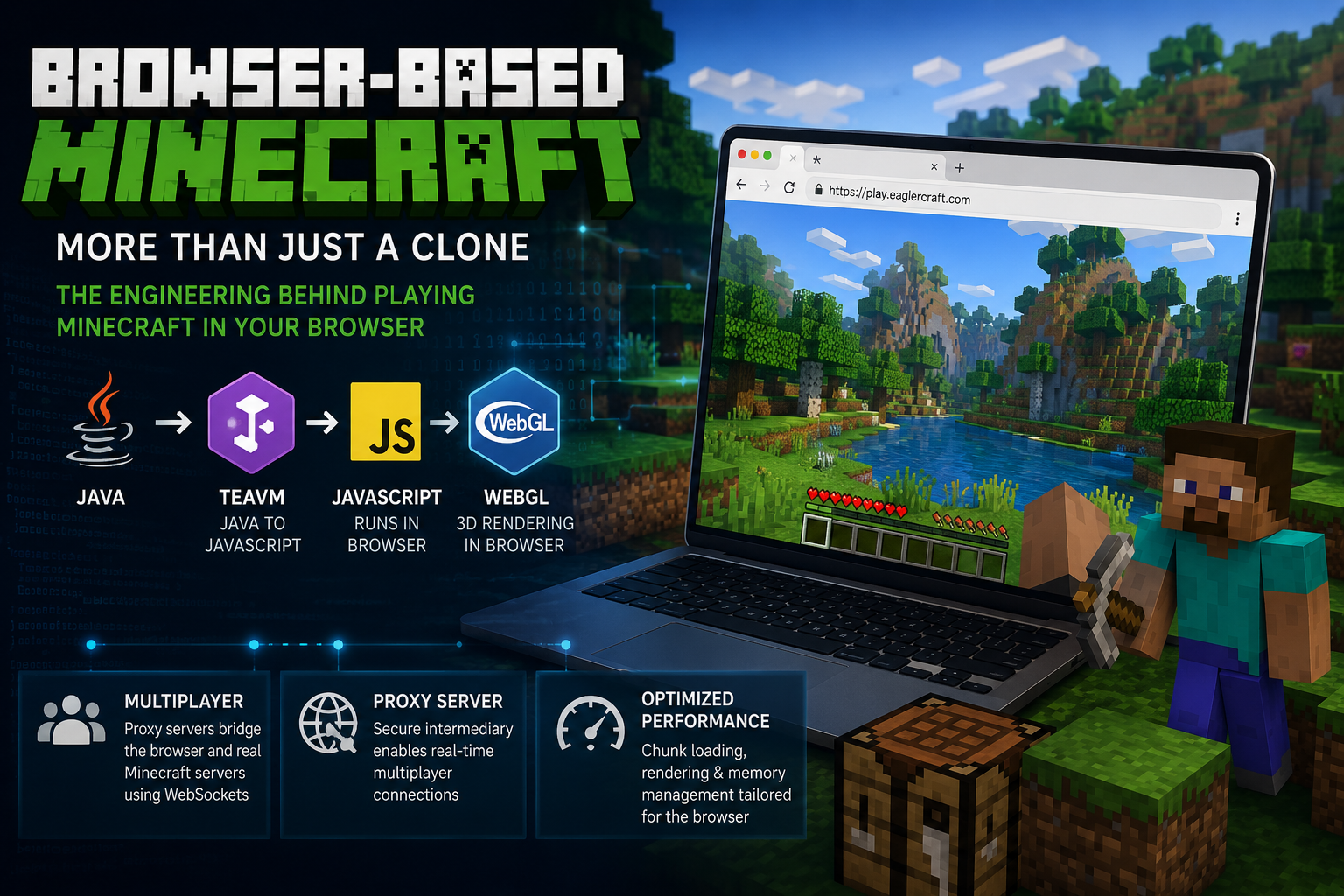
A lot of people dismiss browser-based Minecraft projects as merely clones of the original game, but when you take a look at what is actually taking place underneath, that label does not hold a lot of sway. A number of technical compromises as well as smart engineering decisions result in these versions running within an internet browser, resulting in a complex, Java based 3D game. What appears to be a familiar experience on the surface is actually a reconstruction of game architecture in a totally different setting.
Rebuilding a Java game for the browser
The initial Minecraft was developed in Java and was intended to run on desktop computers with full access to the Java Virtual Machine along with native libraries. This setup also shaped the early growth of real gaming experiences tied to the platform. The environment required by browsers is not supported, preventing developers from simply running the game on the internet.
Instead, programs such as TeaVM are utilized to convert Java code into JavaScript for browser execution. It’s not a perfect translation and this is exactly where things get intriguing. The browser does not act like a conventional desktop runtime and developers still need to reconsider how such things as memory management, game loops, and system timing work.
Rendering worlds using WebGL rather than OpenGL
Another significant change involves graphics. Minecraft uses Java libraries to access the GPU directly on desktop. The direct path is not present in browsers, making WebGL the alternative.WebGL enables the rendering of 3D graphics within a browser tab, however it has limitations and requires optimization. Developers must control chunk loading, minimize rendering overhead and control how textures are prepared to prevent overstimulation of the browser. Even minor inefficiencies can result in noticeable performance decreases.
Multiplayer systems and proxy-based networking
The limitations of browsers become particularly apparent when it comes to multiplayer support. Direct TCP connections are used in traditional Minecraft, but security concerns have caused browsers to deny such access.
Proxy servers are utilized by browser-based systems to circumvent this issue. They function as intermediaries between the game operating within the browser and the real game server. The proxy converts WebSockets, that are permitted in browsers, into regular server traffic. It adds an additional layer, but is necessary for multiplayer to function properly.
Eaglercraft as a practical demonstration of the system
Eaglercraft is a good illustration of exactly how all these fits together. It illustrates the integration of Java code, browser-based rendering, and proxy networking into a functional system that operates in a real environment.
The interesting thing here is not only that Minecraft is able to run in a browser, but how many systems need to be rebuilt or modified to make it possible. It is much less about copying the original game and much more about re-engineering it for an entirely different platform.
The web browser is no longer a “lightweight” environment
Browsers were viewed for a very long time as merely tools for displaying sites and basic apps. The viewpoint has changed considerably. High quality graphics, real time communication and extremely optimized JavaScript execution are now supported by modern browsers.
This is what allows projects such as browser-based Minecraft to exist to begin with. The browser has evolved from a mere viewing tool to a complete runtime environment able to deal with highly interactive systems which previously needed native software.
Why calling it a clone misses the point
These projects are often referred to as clones, but this oversimplifies the reality. They’re not only rewriting gameplay elements and integrating advanced game elements, but rebuilding whole systems to operate under various technical regulations.
At a closer glance, you are able to see a combination of Java-to-JavaScript compilation, WebGL based rendering as well as proxy driven networking working in concert. The end result might look familiar, but the engineering behind it is fundamentally different – and that is the thing to pay attention to.