The digital landscapes of modern Massively Multiplayer Online games (MMOs) have evolved far beyond simple entertainment. Today, titles like EVE Online, Old School RuneScape, and Albion Online operate as living, breathing economic laboratories. In these virtual worlds, thousands of players engage in complex trade, resource extraction, and industrial manufacturing. For a college student, navigating these systems isn’t just a hobby—it is an accidental masterclass in high-level financial theory. The transition from managing a guild’s shared vault to sitting in a corporate boardroom is much shorter than most people realize.
When gamers manage large-scale operations in these titles, they are essentially performing the duties of a junior auditor. They track every transaction, manage supply chains across multiple star systems, and deal with the fluctuating value of virtual currencies. Because these economies are so volatile, many students find themselves needing a specialized Accounting Assignment Help resource from myassignmenthelp to bridge the gap between their practical gaming experience and the rigid academic requirements of a university business degree. Understanding the flow of assets in a virtual marketplace provides a unique “Information Gain” that traditional textbooks often fail to capture.
The Dawn of Triple-Entry Accounting in Virtual Spaces
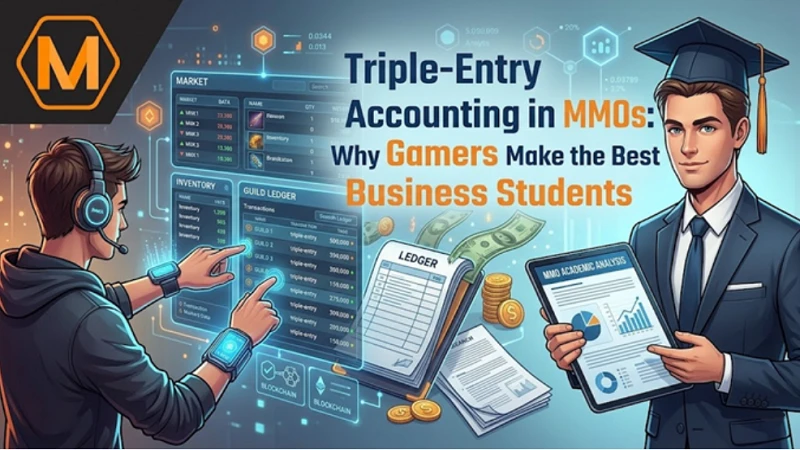
In the real world, the standard for centuries has been double-entry accounting. Every entry to an account requires a corresponding and opposite entry to a different account. However, in the blockchain era and within sophisticated MMO databases, we are seeing the rise of “Triple-Entry” systems. This adds a third component: a cryptographically sealed receipt or a server-side ledger entry that verifies the transaction between two parties.
Gamers are native to this. When a player trades a rare sword to another player, the game server acts as the third entry, creating an immutable record of the exchange. This prevents “item duplication” and ensures the integrity of the virtual economy. Business students who have played these games for years understand the concept of a “trustless” ledger intuitively. They don’t just see numbers on a screen; they see a verified history of value movement.
Why Virtual Marketplaces are the Best Business Simulations
Unlike a sterile classroom simulation, an MMO economy has real stakes. If a guild leader mismanages the “Common Fund,” they face a political coup or total bankruptcy. This environment fosters a level of “E-E-A-T” (Experience, Expertise, Authoritativeness, and Trustworthiness) that is rare in young professionals.
- Supply Chain Management: Players must calculate the “opportunity cost” of mining their own ore versus buying it on the open market.
- Risk Mitigation: Large-scale trade runs in games often involve “pirates” or rival factions. Students learn to hedge their bets, buy insurance, and diversify their assets.
- Inflation Control: Virtual worlds deal with “gold sinks”—mechanisms designed by developers to remove currency from the game to prevent hyperinflation. Gamers understand the velocity of money better than most introductory economics students.
Critical Thinking and Narrative Analysis in Business
Success in business isn’t just about the numbers; it’s about understanding the people behind the numbers. This is where the humanities meet the ledger. A student who can analyze the motivations of a rival guild leader is often the same student who excels at complex literary deconstruction. For instance, performing The Ultimate Character Analysis of Mark Antony in Julius Caesar reveals the power of rhetoric and strategic positioning—skills that are vital when presenting a financial audit or a business proposal. This crossover between strategic gaming, literature, and finance creates a well-rounded professional who understands both logic and human emotion.
The Rhetoric of Corporate Leadership
In Julius Caesar, Mark Antony’s ability to turn a crowd isn’t just about the words he uses, but the timing of his delivery. Similarly, a business leader must know when to pivot their strategy based on market sentiment. Gamers who participate in high-level guild diplomacy are essentially practicing this brand of strategic communication every single day. They learn to manage egos, negotiate trade deals, and lead teams of diverse individuals toward a singular financial goal.
Bridging the Gap: From Gold to Growth
The core of the “Bridge Strategy” in education is taking what a student already knows and applying it to a professional framework. When a gamer enters a business school, they shouldn’t leave their gaming experience at the door. Instead, they should see their time in MMOs as a legitimate internship in digital finance.
The logic used to balance a guild’s budget is the same logic used in forensic accounting. The grit required to “grind” for a rare resource is the same grit required to complete a 10,000-word research paper on macroeconomic trends. By viewing gaming through a professional lens, students can reduce their “cognitive load” and find joy in subjects that others might find dry or boring.
The 2026 Shift: Why Employers Value “Gaming Literacy”
As we move further into a digital-first economy, employers are looking for “Agentic” thinkers—people who can take a goal and find the most efficient path to achieve it without constant supervision. Gamers are naturally agentic. They are used to being dropped into a world with zero instructions and figuring out how to dominate the local market.
| Skill Learned in MMO | Business Application | Academic Equivalent |
| Guild Management | Human Resources | Organizational Behavior |
| Market Flipping | Day Trading | Financial Derivatives |
| Raid Optimization | Project Management | Operations Research |
| Ledger Balancing | Auditing | Triple-Entry Accounting |
Advanced Macroeconomics: The “Gold Sink” Phenomenon
One of the most difficult concepts for business students to grasp is how central banks control inflation. In a game like World of Warcraft, developers act as the central bank. They notice when there is too much currency in the system, which causes the price of basic items like “Health Potions” to skyrocket. To fix this, they introduce “Gold Sinks”—high-cost items like expensive mounts or repair costs—that remove money from the economy entirely.
A student-gamer who has lived through a “market crash” in an MMO has a visceral understanding of monetary policy that no textbook can provide. They understand that if you print too much money (or “farm” too much gold), the value of everyone’s savings drops. This practical experience makes them incredibly dangerous in a macroeconomics classroom because they aren’t just memorizing formulas; they are recalling lived experiences.
The Data Science of the “Meta”
In gaming, the “Meta” (Most Effective Tactic Available) is constantly shifting. Players use massive spreadsheets and community-driven data to figure out which character builds or economic strategies are currently winning. This is exactly what data scientists do in the corporate world. They analyze “big data” to find the most efficient way to market a product or manage a budget.
College students who “theorycraft” their gaming builds are essentially performing high-level data analysis. They look at variables, constants, and outliers to predict an outcome. When these students transition to business analytics assignments, they find that the logic is identical. The only difference is that instead of optimizing “Damage Per Second,” they are optimizing “Return on Investment.”
Strategic Networking and Global Collaboration
Most modern business happens across borders. A content strategist in Singapore might work with an editor in London and a developer in New York. Gamers have been doing this for decades. A typical high-level gaming group might include people from five different continents, all speaking a common technical language to achieve a difficult goal.
This cultural intelligence is a massive asset in business school. While other students might struggle with the dynamics of a diverse group project, a gamer is already comfortable navigating different time zones, accents, and communication styles. They know how to lead a “remote team” because they’ve been doing it since they were twelve years old.
Final Thoughts: The Human-First Approach to Finance
At the end of the day, whether you are managing a fortune in EVE Online or a corporate portfolio in Singapore, the principles remain the same: transparency, strategy, and resilience. We must move away from the idea that gaming is “wasted time.” Instead, we should recognize it as a high-fidelity simulator for the modern world.
For the college student struggling with their coursework, remember that you have already solved harder problems in the virtual world than you will likely face in your first semester of accounting. You just need to translate those “game mechanics” into “business mechanics.” When you treat your degree like a high-level quest, the path to the first page of your career becomes much clearer. The skills you’ve honed in the digital trenches are the very tools that will make you a leader in the global marketplace.
Frequently Asked Questions
How does gaming experience translate to professional business skills?
Virtual economies require players to manage limited resources, analyze market fluctuations, and coordinate international teams. These activities mirror real-world supply chain management, financial auditing, and project leadership, providing a practical foundation for complex corporate environments.
What is the benefit of triple-entry accounting in digital systems?
Unlike traditional methods, this system uses a third, independent verification layer—often a server-side ledger or blockchain. This creates an immutable record of transactions, significantly reducing the risk of fraud and improving the transparency of financial data.
Can analyzing literature improve strategic business communication?
Yes. Deeply examining character motivations and rhetorical techniques in classic texts helps develop an understanding of human behavior and persuasion. These insights are essential for negotiating deals, leading diverse teams, and presenting compelling financial arguments.
Why is “Information Gain” important for modern research?
Information Gain focuses on providing unique insights or data that aren’t already available in standard resources. By applying lived experiences—such as insights from virtual marketplaces—to academic frameworks, researchers create more original, authoritative, and high-impact content.