
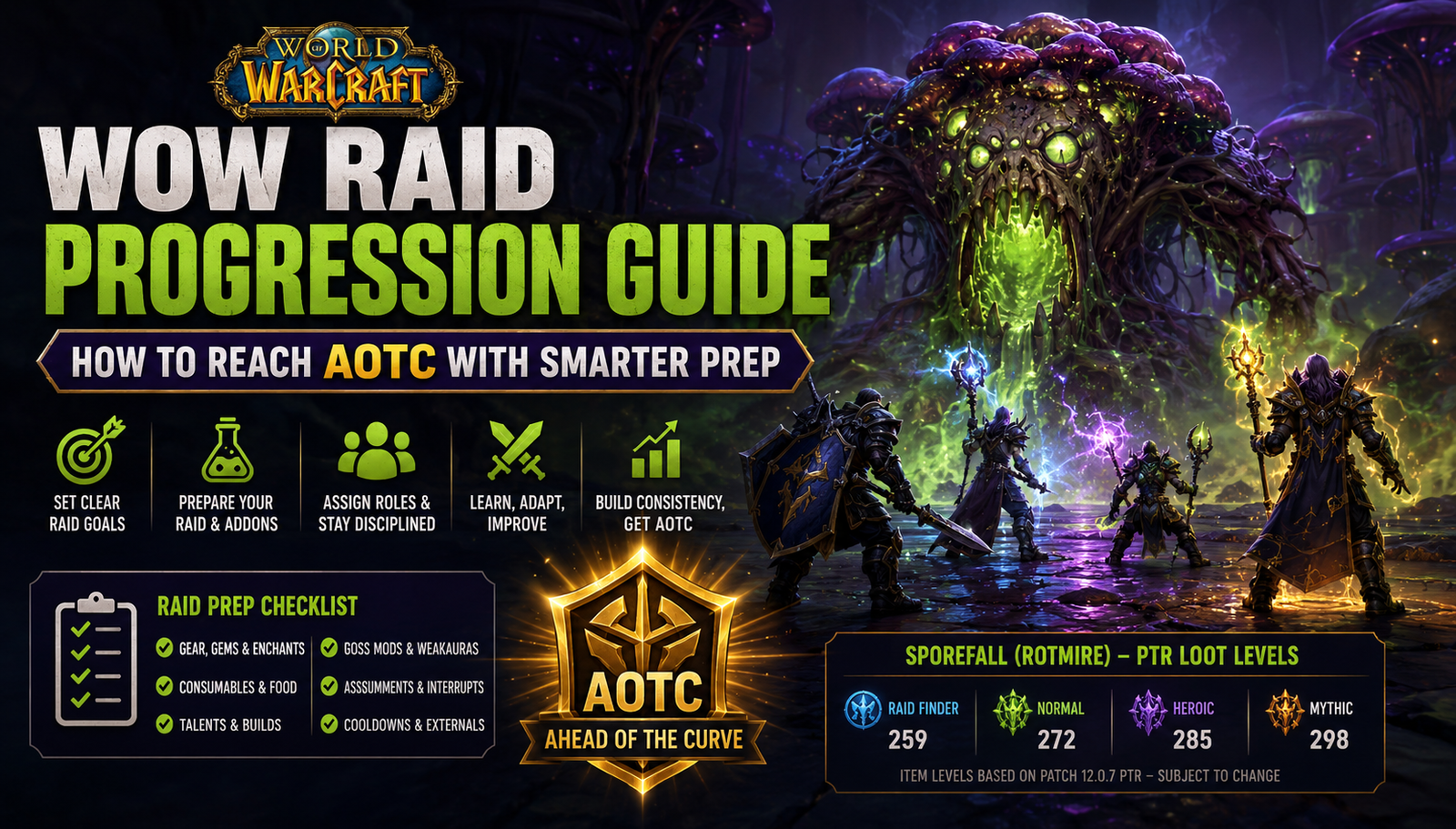
Getting to the AOTC is no easy task, since you need not only good personal skill, but also a reliable party, enough resources and consumables, and sometimes, even a certain raid comp. But even well-planned raiding parties get there through practice, by improving on what they do before, fixing the things they constantly make mistakes on, and treating every respawn as progress.
That’s the main reason why getting the Heroic achievement is so hard — you need everything well-planned and coordinated. You will find the raid preparation tips useful closer to the Sporefall raid release, so that’s one of the best examples of how planning helps to get AotC.
Why Some Groups Reach AOTC Faster
Each season, WoW raid groups start their way to the AotC. Some well-established teams do it faster during the RWF championship, guilds and pugs usually follow them closely. But for some players, Ahead of the Curve becomes a seasonal goal, and with each week passing without the achievement, players start losing faith. What’s the main reason for that? Why does some group get AotC on week 1 while others struggle queuing back to back with no results?
Well, faster progressing teams have several simple tricks up their sleeves:
- They are clear on what they need to accomplish this week.
- Their raid night comes fully prepped with assigned roles.
- They keep their communication short and precise.
- They tackle each big problem individually.
What’s even more important, the best groups know that randomness is the enemy of consistency. This particular point is very important since some raids pull off one impressive kill during WoW Midnight raids and call it stability. That’s simply not true. Constant training, testing pulls, and correcting mistakes is what makes consistency in raiding. Also, checking logs and pointing out the weakest spots can help.
How to Set the Right WoW Raid Goals Before Your First Pull
If you want to try out a new boss, or your goal is to get a one-shot kill and AotC in one go, keep in mind that planning makes up 90% of success. With that being said, the situations in which a raid team without a clear target often wastes half the night deciding what kind of group it actually is are pretty common. That is why the first job is not pulling the boss but setting and discussing the goal. Of course, it’s harder to do with pugs, but explaining the plan to randoms is usually worth the effort.
This matters because your target changes how you raid. A group doing casual learning (relaxes, progression) runs should not act like a Mythic roster. On the other hand, a team that says it wants Heroic progression cannot spend the night winging assignments and hoping that gear or a few experienced top-tier specs carry the pull.
| Goal | Best For | What It Really Means |
| First clear | casual groups or alts | learn the fight and secure the kill |
| Heroic progression | weekly teams | build repeatable mechanics and sharper execution |
| Weekly farm | stable rosters | faster clears, better loot flow, less wasted time |
| Cutting Edge prep | serious groups | stronger discipline, cleaner comps, fewer weak links |
Best WoW Raid Preparation Tips Before Starting Progression
Before even beginning progress on any new WoW Raid content, the group must consider these important items:
- talents and builds;
- consumables, enchants, and gems;
- boss mods and helpful WeakAuras;
- cool downs and externals;
- interrupts and movement teams.
If you have a pre-made raid group, discuss these points in advance. If you are pugging, dedicate a few minutes to discussing it all in chat and asking everyone to check their talents, pots, and update the addons. And don’t forget to check whether you meet all these requirements.
A simple checklist keeps the group ready:
| Preparation Area | What to Confirm |
| Gear | item level, trinkets, enchants, gems |
| UI | boss timers, debuffs, visibility |
| Consumables | flasks, food, potions, healthstones |
| Assignments | kicks, immunities, externals, movement |
| Expectations | target for the night, break timing, voice discipline |
If a group for the raid is unstable, or if real life leaves almost no raid time that week, a scheduled WoW Sporefall Raid Boost can be a cleaner option than gambling on several bad pug nights. Used that way, a Sporefall raid boost is less about skipping the game and more about protecting one reset from turning into dead time.
How to Improve WoW Raid Progress After Early Wipes
It’s pretty common to wipe early on, both for the pre-mades and pugs. What is not okay at all is learning no lesson from the wipe that has just occurred. A lot of raid leaders try to explain everything at once before the pull and start kicking players that made one mistake after the first wipe. That usually creates more noise, not more progress. If you are a raid leader or take responsibility for making sure your raid group is on the same page, do this after a wipe:
- Identify the real cause of the mistake/
- Choose one change that addresses it.
- Explain that change clearly.
- Keep the rest of the plan stable.
- Pull again before the group loses focus.
This is possible since most wipes are not usually caused by ten factors at once, but one single factor that sets off the chain reaction to the other problems: it might be position, it might be a panic action, it might be one single failure that causes the entire pull to fail. That said, if you address the true problem, everything will look much better next time.
Surely, you are free to remove the “trolling” players from the raid, but not everyone is trying to spoil your experience. Just be patient and let the group take their time. You might not get the kill on firt try with this approach, but the second or third attempt can finally get you AotC.
Common WoW Raid Progression Mistakes That Slow Down AOTC
Most groups do not fail progression because the boss is unbeatable. They fail because they repeat avoidable habits for weeks.
| Mistake | Why It Hurts Progress |
| Changing strategy every pull | no one builds reliable habits |
| Weak callouts | players miss the same mechanics again |
| Greeding damage | deaths happen before the hard phase |
| Poor attendance | learning resets every week |
| No role clarity | key tools overlap or never get used |
There’s a pretty common mistake, especially among the new players: some groups think time spent equals learning gained. It does not. Twenty bad pulls can teach less than five focused ones. That is part of why Sporefall boosting is highly popular with the new raid tiers. Players usually are not searching for some magical shortcut when choosing Sporefall boost; they simply don’t want to have too many hours lost to bad structure.
Why Weekly WoW Raid Runs Matter for Faster Heroic Progress
Whereas an individual killing a World of Warcraft raid boss will feel wonderful, having clean clears on a weekly basis matters more. The repetition by the stable groups develops familiarity that enables them to perform better. The healers know when the pressure will hit. The tanks learn to pace their movements. The DPS players know when they do not have to throw pulls just for a little progress.
This is why weekly runs matter greatly. It is due to this reason that a few gamers try to seek out a WoW Sporefall Boost after a tough reset. It is because they do not need it for an ego boost at all. In many cases, they just need one good run to feel like the week was worth something.
Sporefall is a good example of that weekly value. On the current Patch 12.0.7 PTR, Rotmire’s loot drops at the highest Season 1 raid item levels, with each difficulty giving a clear reward step. The raid is still on PTR, so these numbers may change before live release, but they already show why one clean weekly clear can be worth planning around.
| Sporefall Difficulty | Current PTR Item Level |
| Raid Finder | 259 |
| Normal | 272 |
| Heroic | 285 |
| Mythic | 298 |
How Sporefall Reflexes Modern WoW Raid Progression
Sporefall becomes a suitable illustration of a modern raid encounter due to its simple nature. It is a one-boss raid in Harandar designed specifically with Rotmire in mind, and the current patch setup makes it particularly interesting due to its scalable Mythic group size of 15-25 players.
This gives us several valuable insights into raiding:
- Short raids still punish bad planning;
- One-boss raids leave no room for carelessness;
- Heroic raids rely on discipline, not gear;
- A stable design always wins over emotional reactions.
It is also why people sometimes mention WoW Sporefall boosting when talking about seasonal objectives. In reality, what they are referring to is control. They need an organized group, fewer mistakes, and an easier route through the current raid, rather than having to start each hour afresh.
Sporefall also has a рщке loot pool, which makes it easy to evaluate its weekly worth. The Rotmire drops listed on PTR item pages include armor, jewelry, and trinkets. Although there is still time for changes until the release of Sporefall, the existing pool alone is enough to explain why the raid seems like a weekly goal rather than gearing one.
| Sporefall Drop | Slot / Type |
| Festerbloom Crown | Leather Head |
| Luxurious Loamstriders | Cloth Feet |
| Mycomancer’s Rot Robes | Cloth Chest |
| Putrid Tender’s Battleplate | Plate Chest |
| Sash of the Putrid Giant | Leather Waist |
| Fungarian Folly Faulds | Mail Legs |
| Grudgefiend Stompers | Mail Feet |
| Girdle of Devouring Rot | Plate Waist |
| Rotmire’s Sporeheart | Neck |
| Sporecaller’s Blooming Loop | Ring |
| Sporelord’s Mycelial Insignia | Trinket |
In summary, PTR shows that Rotmire has to offer several armor items, which include Festerbloom Crown, Fungarian Folly Faulds, Girdle of Devouring Rot, Grudgefiend Stompers, Luxurious Loamstriders, Mycomancer’s Rot Robes, Putrid Tender’s Battleplate, and Sash of the Putrid Giant.
It is worth paying attention to the accessories, as this gear type determines raid value. For example, Rotmire’s Sporeheart is a neck piece with a healing-based protective effect; Sporecaller’s Blooming Loop is a ring with Nature damage and Rotbloom abilities; finally, Sporelord’s Mycelial Insignia is a trinket, which may give you a random secondary stat and Leech.
When Organized WoW Raid Runs Make Sense for Progression
Guild raiding will always be the most optimal choice for many players. It encourages good habits, builds trust, and improves communication skills over time. However, not every player has a reliable guild every single week, and not every alt or end-game character can afford to wait for the ideal guild raid schedule.
This is where organized raid assistance can become a natural part of overall progression. A Sporefall carry might work well for a person who knows the fight but does not have a reliable group that week. Similarly, a WoW Sporefall carry might suit someone looking to get caught up on content without wasting several resets on unreliable groups.
What matters is the intent behind the use of organized assistance. A one-time event used to ensure success, catch up to one’s friends, or maintain progress towards seasonal goals is an understandable choice. This approach makes much less sense when someone hopes to rely on external help rather than learn the basics of raiding.
Final WoW Raid Progression Tips for Reaching AOTC More Consistently
The road from first pull to Heroic success is rarely flashy. It is built on repeatable habits.
Keep the formula simple:
- set one real goal for each reset
- prepare before raid time begins
- review wipes without overexplaining them
- value stable clears over dramatic pulls
- use current raids like Sporefall to sharpen universal habits
That is the smarter way to raid in WoW, and it still works when a new boss arrives. It still works when the next tier replaces the current one. And it is usually the reason one group reaches the finish line while another keeps starting over.