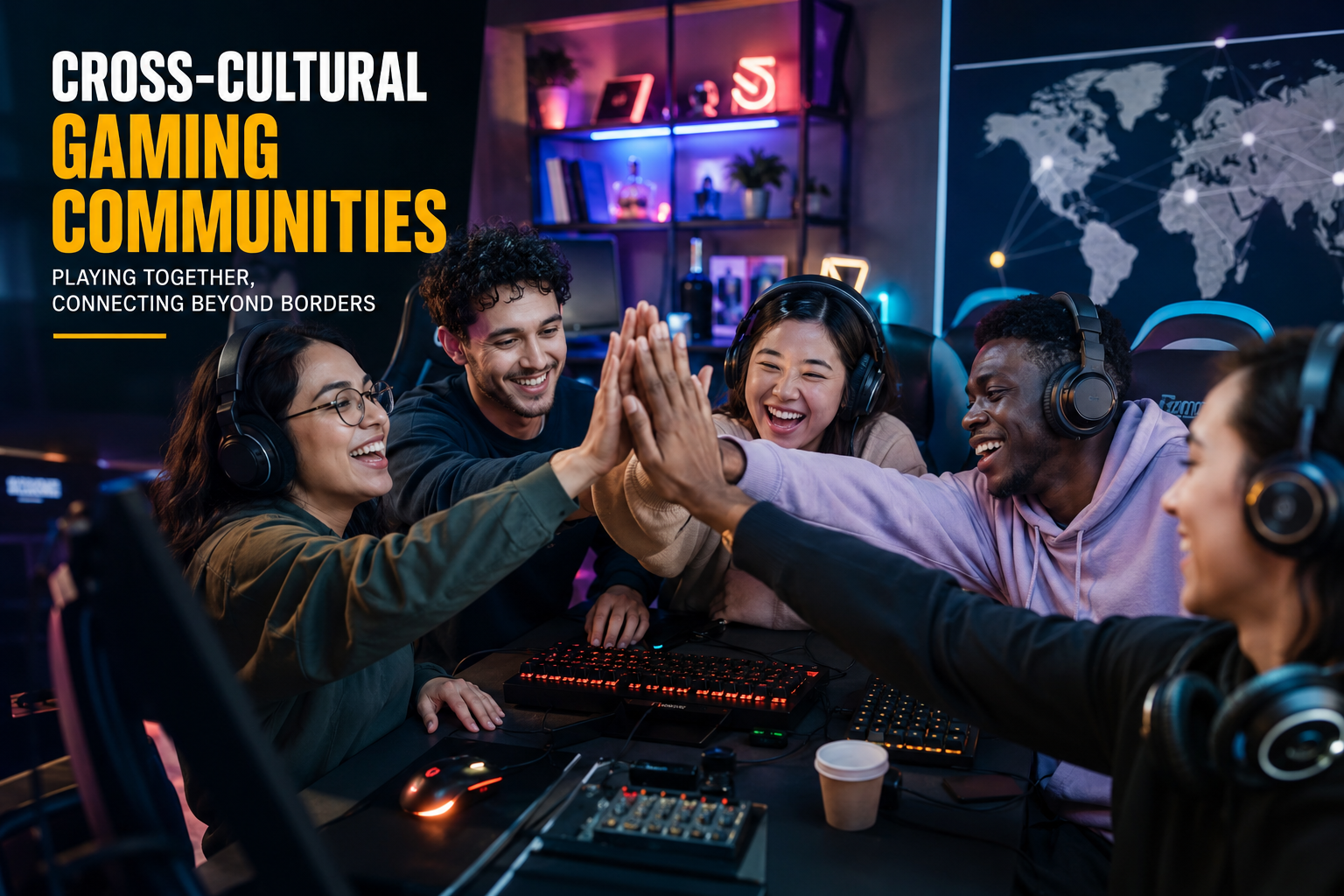
Cross-cultural gaming communities place people with different reference points on the same team, where a shared objective can set the tone for conversation. The contrast with purely competitive spaces is not about declaring one format superior. It is about recognizing which conditions give relationships room to persist beyond a result screen.
Shared objectives create a social bridge
Cooperative play offers a practical starting point: players coordinate roles, exchange information, and solve group problems around the same outcome. Repeated sessions can reveal different playing styles without asking anyone to speak for an entire country or culture. For readers exploring gaming-related work alongside community life, side hustles for gamers can be a relevant starting point when the focus stays on legitimate, constructive opportunities.
A study of 4,035 League of Legends games involving 102 multicultural teams found that cultural diversity improved team-strategy quality when a shared gamer identity became salient. That finding concerns multicultural esports teams, not every game community, yet it illustrates the value of a common purpose. Research on online gaming also links social value to the quality of interaction and relationships, rather than time spent playing.
That distinction matters in cross-cultural groups. National labels can become shortcuts, whereas a shared role and clear objective direct attention toward the next coordinated action. Cooperation does not guarantee understanding or tolerance, but it can provide a setting where communication has an immediate purpose and continued participation has a social payoff. Players still need active inclusion and respectful norms for that payoff to emerge.
Cross-cultural communities can also expose players to different communication habits without requiring formal cultural education. One player may prefer direct instructions, while another may communicate more cautiously or rely heavily on visual cues, gestures, or game mechanics. Over time, repeated cooperation can make these differences easier to recognize and accommodate. The important factor is not eliminating cultural differences but creating enough shared experience for players to understand how those differences affect teamwork.
What competition keeps and cooperation adds
Purely competitive spaces can create friendships, shared rituals, and team identity. A contest gives people a clear reason to return and improve together. The pressure of a high-pressure ranking environment may leave less room to resolve cultural misunderstandings, though it does not erase the social value of competition.
Cooperative communities place greater emphasis on coordination, which can support social continuity across recurring sessions. Conversations often continue in voice chat, forums, streaming spaces, or community management channels after play. This wider network gives members places to organize future sessions and maintain relationships.
Competitive communities can still build durable bonds when members return for familiar teammates and recognize one another’s contributions. The challenge appears when status pressure dominates every exchange. In that atmosphere, a misunderstanding can be treated as evidence of difference instead of a moment to clarify intentions and rebuild trust.
Neither approach automatically creates inclusion. Gaming communities can reproduce exclusion, out-group bias, discriminatory practices, language barriers, and in-group behavior. Clear conduct expectations, accessible communication tools, mixed teams, and room for different communication styles are supportive community choices.
Community leaders can also set simple habits around introductions and feedback. Inviting members to state preferred communication methods can reduce unnecessary friction. A clear way for people to report harmful conduct helps keep inclusion part of the group’s routine.
Another advantage of a well-managed cross-cultural community is the opportunity to build familiarity through repeated, low-stakes interaction. Players do not necessarily need to have deep conversations about culture to develop stronger understanding. Playing several matches together, learning how teammates react under pressure, and discovering individual strengths can gradually replace assumptions with personal knowledge. In this sense, games can provide a practical environment where relationships develop through shared activity rather than abstract ideas about nationality or identity.
Building communities that last beyond the match
The long-term value of a gaming community depends partly on what happens between sessions. A group that only measures success through wins and losses may struggle to retain members who are still learning, have different skill levels, or participate primarily for social reasons. Communities that recognize helpful communication, reliability, mentorship, and positive teamwork can give members additional reasons to remain involved.
This does not mean removing competition. Competitive goals can coexist with social structures that encourage players to support one another. A tournament team, for example, can compete intensely while maintaining respectful communication and making room for players from different backgrounds. The distinction is between competition as an activity and competition as the only measure of a member’s value.
Cross-cultural communities are particularly well suited to this broader approach because they already bring together people who may have different experiences outside the game. When members are encouraged to contribute according to their abilities rather than conform to a single communication style, diversity becomes part of the community’s working structure rather than merely a demographic characteristic.
Buying games with community in mind
Digital games are available through official platform stores or digital marketplaces. Eneba is a digital marketplace for game keys and gift cards, with product pages that show regional compatibility and platform information.
Cross-cultural connection grows through ordinary choices. Returning to the same group and giving every member a role in a shared objective can help conversations continue. The purchase itself is simple; the relationships formed around play deserve more care. Digital marketplaces like Eneba offer deals on digital products and provide a practical route to games and gift cards. That leaves players free to focus on the communities they want to build.
Ultimately, the strongest argument for cross-cultural gaming communities is not that cooperation is always better than competition. Competition can motivate players, create memorable moments, and strengthen team identity. The case for cooperation is that it can create additional opportunities for communication, familiarity, and sustained relationships. When players have a reason to work together repeatedly, differences that might otherwise become barriers can become ordinary parts of getting a team to function. With thoughtful moderation and inclusive community practices, gaming spaces can therefore become places where the shared objective matters, but the people working toward it matter too.