Gaming stereotypes can distort decisions in boardrooms, classrooms, and marketing plans. They reduce a huge audience to one imagined personality, even though players span generations, identities, play styles, and reasons for participating. A better view starts by separating familiar assumptions from evidence.
Creator activity adds another layer that outdated labels often miss. Resources about how to make money on roblox fast reflect an intersection of games, entrepreneurship, and digital culture, but they do not turn ordinary play into guaranteed income. Businesses that treat every player as identical will miss that wider context.
The myths that flatten a diverse audience
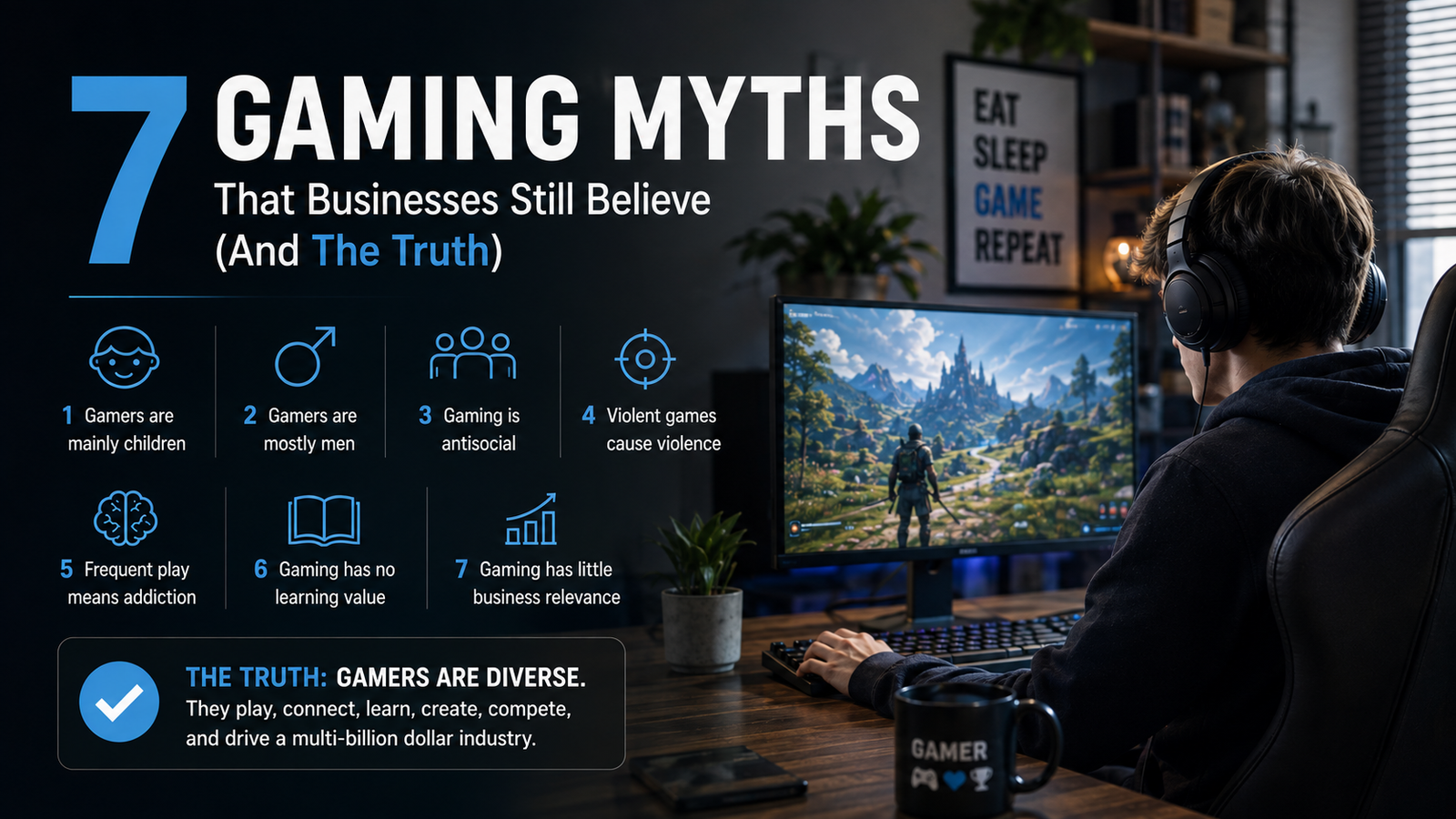
- Gamers are mainly children. The Entertainment Software Association’s 2024 U.S. report put the average player age at 36, while the average adult player had played for 17 years. Gaming can be part of childhood, adulthood, and family life rather than a phase with a fixed end point.
- Gamers are mostly men. The same ESA report found that 53% of U.S. players identified as male and 46% as female, with about 1% choosing nonbinary or prefer-not-to-identify responses. People may relate to the word “gamer” differently, yet the population of people who play is plainly not exclusive to one gender.
- Gaming is inherently antisocial. ESA reported that 55% of players across all ages played with others each week, and 83% of gaming parents played with their children. Pew found that about nine in ten U.S. teen players played with others in person or online, while 47% had made an online friend through a video game.
- Violent games directly cause serious violence. The American Psychological Association reported insufficient scientific evidence for a causal link between violent games and violent behavior. Its position recognizes a small, reliable association with some aggressive outcomes, yet says that evidence does not support treating games as a direct cause of serious violence.
The myths with business consequences
- Frequent play automatically means addiction. The World Health Organization describes gaming disorder through impaired control, priority given to gaming over other activities, continued behavior despite negative consequences, and significant impairment across important areas of life. It affects only a small proportion of people who play, so enthusiasm or regular use alone is not a clinical diagnosis.
- Gaming has no learning value. A 2022 study in Nature Human Behaviour found improvements in reading, attention, and planning among 151 children after a purpose-built video-game intervention, with reading benefits still present six months later. That focused result cannot prove that every commercial game improves intelligence, school outcomes, or work performance.
- Gaming is only entertainment and has little business relevance. In its 2024 economic-impact report, the ESA estimated that the U.S. video-game industry supported 350,015 total jobs and generated $101.4 billion in total economic impact during 2023. Those are modeled estimates commissioned by an industry trade association, yet they illustrate why employers, educators, and publishers should take the sector seriously.
The commercial side of gaming also demonstrates why the audience should not be viewed through a single lens. Players may purchase full games, downloadable content, subscriptions, virtual items, gift cards, or other digital products. Others participate in creator economies, stream gameplay, build communities, compete professionally, or develop content around games. These activities create different motivations and spending patterns, making it difficult for businesses to understand the market through stereotypes alone.
Players can buy digital games through official platform stores or digital marketplaces. Eneba is one option for game keys or gift cards, with product pages that can show platform details and clear region information for a more transparent selection.
These seven myths persist because one label compresses a varied audience into a simple caricature. Digital marketplaces like Eneba offering deals on digital products fit the broader picture: games sit within a diverse culture that includes play, connection, creator activity, and substantial commercial activity.
For businesses, the practical lesson is straightforward: understanding players requires looking beyond the stereotype. A teenager playing casually with friends, a parent enjoying games with their children, a competitive esports participant, and a creator building an online audience may all identify with gaming in very different ways. Treating them as one homogeneous group can lead to inaccurate assumptions about their interests and behavior. Moving beyond these myths allows publishers, advertisers, educators, and other organizations to approach gaming audiences with greater accuracy and a better understanding of the culture surrounding modern play.