
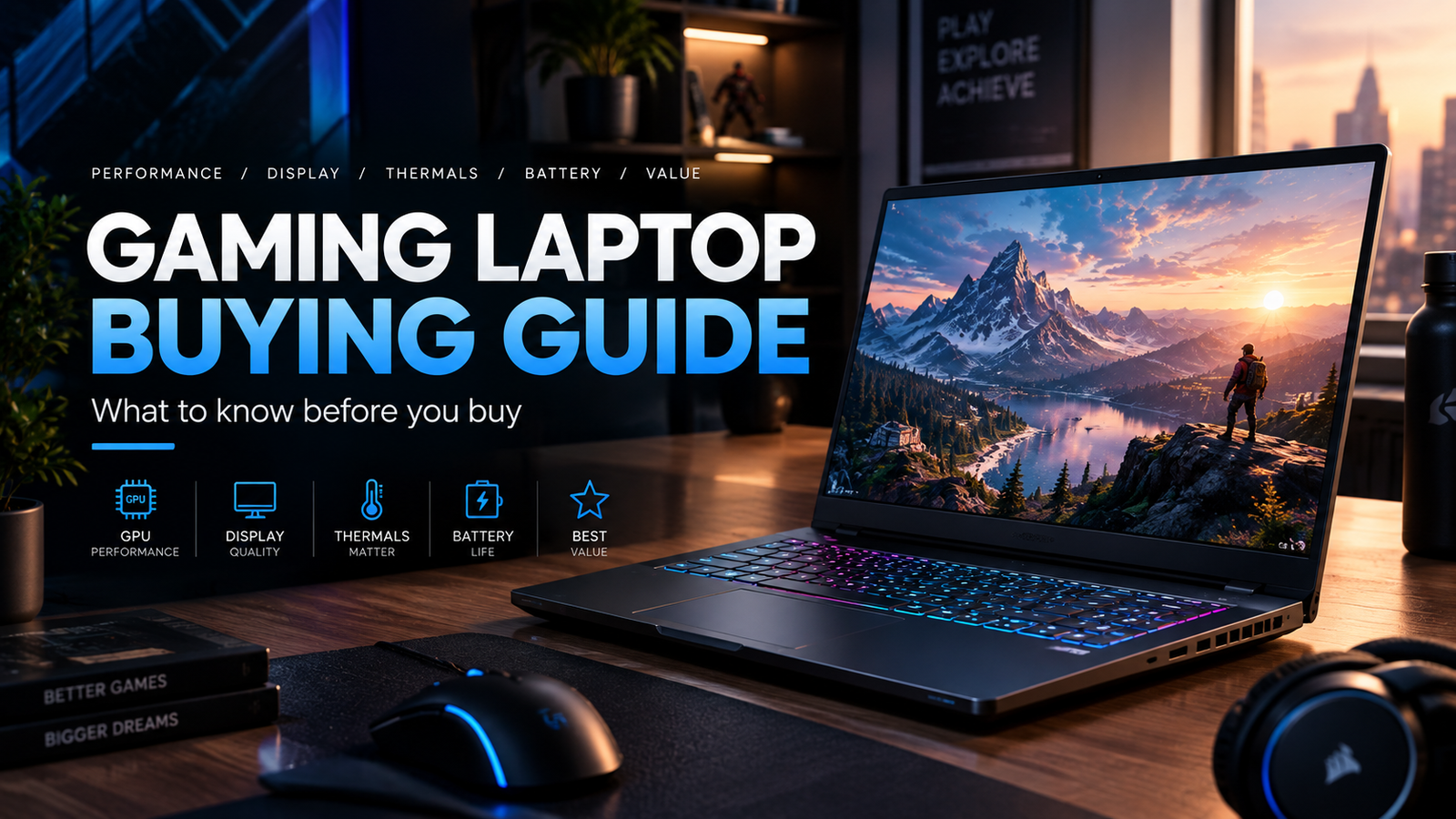
Gaming laptops have always required a different set of considerations than desktop gaming PCs, and the buying decisions that matter most are not always the ones that get the most attention in spec comparisons. Understanding what to prioritize, what to accept as a tradeoff, and where the current generation of hardware has genuinely changed the equation produces better purchase decisions than treating a gaming laptop like a portable version of a desktop gaming PC.
The Fundamental Tradeoff That Has Not Changed
The core tradeoff in gaming laptops remains what it has always been. A laptop trades the upgradability, thermal headroom, and cost efficiency of a desktop for portability that a desktop cannot match. This tradeoff is worth making for buyers who genuinely need to game away from a fixed location, who want a single device that handles both portable productivity and serious gaming, or for whom desk space and setup complexity make a desktop impractical.
It is not the right tradeoff for buyers who will use the laptop primarily at a desk. At any given budget, a gaming desktop consistently delivers more performance than a gaming laptop because the components are not thermally constrained by a slim chassis, the GPU is not a mobile variant with reduced power limits, and the same money buys significantly more capable hardware in a desktop configuration.
Understanding which category you are in before comparing specs produces a cleaner purchase decision than trying to optimize across both use cases simultaneously.
The Display Is More Important Than Most Buyers Account For
The display in a gaming laptop is a component that you interact with every session and that determines how the games you play actually look and feel, but it receives significantly less attention in most buying decisions than the GPU and CPU numbers. In the current generation of gaming laptops, display quality has improved enough that the panel choice is genuinely meaningful rather than just a marketing distinction.
The jump from a standard 1080p 60Hz panel to a 1080p 144Hz panel is the most impactful single display upgrade available for competitive gaming because the refresh rate directly affects how smooth motion appears and how responsive inputs feel. Above 144Hz, the returns diminish for most gaming applications, but 240Hz and 300Hz panels in the current Chimera lineup are meaningful for competitive players whose titles and hardware can push those frame rates.
QHD and QHD+ resolutions at 2560×1600 produce noticeably sharper images than 1080p on screens above 15 inches, which matters more for single-player and visual games where image quality enhances the experience and matters less for competitive titles where frame rate is the priority.
The OLED panel in the RDY Chimera NP6750N at $1,999 with Intel Core Ultra 7 356H and RTX 5060 represents a display quality step that IPS and TN panels at any refresh rate cannot match, with per-pixel lighting that produces perfect blacks, vibrant colors, and contrast ratios that change how visually rich games look in the same way that an OLED television changes how HDR content looks compared to an LCD.
The Four Tiers in the Current Lineup
iBUYPOWER’s gaming laptops span four performance tiers that each represent a distinct use case rather than simply a price ordering of the same experience at different quality levels.
The starter tier at $1,549 with the Chimera NP5251M pairs an Intel Core 7 250H with a GeForce RTX 5050 on a 15.6-inch 1080p 144Hz display. This is the configuration for buyers who need laptop portability and want to game casually, play less demanding titles at comfortable settings, or have a gaming-capable machine for occasional gaming alongside primary productivity use. It is not the configuration for buyers who expect to run demanding AAA titles at high settings with consistent high frame rates.
The mid tier from $1,899 to $1,999 includes the Chimera NP7560N with RTX 5060 on a 16-inch QHD+ 300Hz display and the Chimera NP7560P with RTX 5070 on the same panel at the same price point with a significant GPU step. The RTX 5070 at $1,999 in the NP7560P represents exceptional value for its GPU tier and is the configuration that most buyers who want genuine high-performance portable gaming should give the most serious consideration.
The elite tier at $2,449 with the Chimera NP9561R brings an Intel Core Ultra 9 290HX alongside an RTX 5070 Ti on a 16-inch QHD+ 240Hz display. The processor step to the Core Ultra 9 290HX is meaningful for workloads that benefit from additional cores alongside the GPU power increase from the 5070 Ti.
The extreme tier from $3,399 to $3,949 with the Chimera NP9581S and NP9581T scales to RTX 5080 and RTX 5090 24GB respectively on 18-inch QHD+ 240Hz displays. The RTX 5090 with 24GB of VRAM in a laptop represents desktop-adjacent GPU performance in a portable form factor, with the thermal and power demands that require the larger chassis and cooling infrastructure of an 18-inch design to sustain under extended gaming loads.
What the Free Peripherals Actually Change
Every gaming laptop purchase currently includes a free Corsair M75 RGB gaming mouse, which is a genuinely useful peripheral rather than a promotional gimmick. A quality gaming mouse is one of the most impactful peripheral upgrades available for competitive gaming, and receiving one with the laptop purchase means buyers do not need to budget separately for an input device that will see as much daily use as the laptop itself.
Intel laptop purchases also include a free iBUYPOWER IEM mouse pad while supplies last, adding a surface that complements the Corsair mouse and completes the portable gaming peripheral setup without additional spend.
Thermal Management: The Hidden Variable
The thermal management of a gaming laptop determines how consistently it performs under sustained gaming loads, and it is the specification that most buyers have the least visibility into before purchase. A laptop that delivers its rated performance in a five-minute benchmark but throttles significantly during a two-hour gaming session is a worse gaming laptop than the specs alone suggest, and this distinction is not visible from the GPU model number or the clock speed on a product page.
The Chimera lineup’s cooling architecture is designed around sustained gaming workloads rather than peak benchmark performance, which reflects the reality of how gaming laptops are actually used. The 18-inch chassis models have the most thermal headroom, which is part of why that form factor makes sense for the RTX 5080 and RTX 5090 configurations rather than attempting to fit those GPUs into a 15 or 16-inch chassis at reduced power limits that would compromise their performance relative to what the GPU model number implies.
Battery Life: Setting Accurate Expectations
Gaming laptops do not have desktop-comparable battery life and should not be expected to. Under gaming loads, a gaming laptop with a dedicated GPU draws far more power than the battery can supply, which means gaming performance is reduced when running on battery alone. The practical expectation for gaming on battery is reduced frame rates and settings compared to plugged-in performance.
For productivity tasks including document editing, web browsing, video streaming, and light creative work, gaming laptops deliver reasonable battery life that varies by model and usage intensity. Buyers who need full-day battery life for productivity should treat gaming laptop battery specs with realistic expectations and plan to game primarily when a power source is accessible.